

Great Mother Archetype & the Modern Relationship Crisis
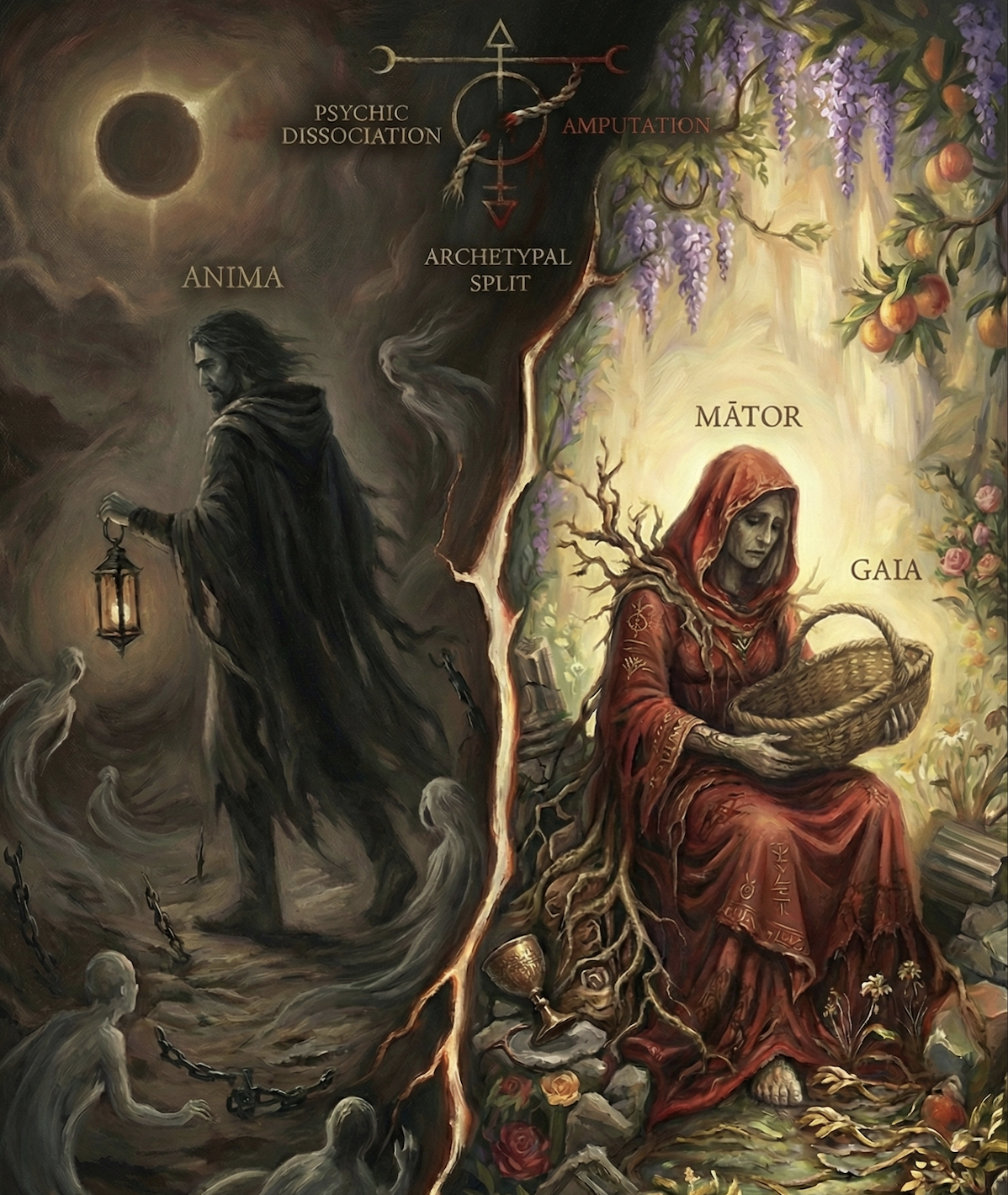
A recent Pew survey, summarized by DePaulo (2020), reports that half of socially single U.S. adults are not interested in a romantic relationship or even a date. Most striking, 71% of single women over 40, compared with 42% of men, say they are not looking for romance (DePaulo, 2020). This staggering asymmetry suggests more than changing preferences. With animus meaning “spirit” and mother linking the Latin root mātor to matter and mother, these data points can be read as an archetypal split: the inner masculine as a wandering spirit, and the maternal pole of matter (mother) withdraws.
Hillman warns that when we reduce imaginal figures to abstractions, “Peris, or Great Mother, . . . we have smashed the image in favor of the idea behind it,” and thereby “depotentiate the power of the imagination” (Hillman, p. 74). In a culture that translates Mother into a fragmented lifestyle amid hyper-productive expectations or into childlessness as a vogue empowerment signal, the Great Mother archetype may no longer constellate as a living psychic presence, thereby depotentiating its power.
Jaffé describes the modern condition as one in which “the world is split apart in ideological dichotomy, science is fragmented, and man suffers from psychic dissociation” (Jaffé, p. 132). The survey embodies this dissociation: animus as disembodied spirit possesses the collective in the form of radical independence and self-protection, while Gaia is treated as a resource rather than a womb, and children—literal and psychic—grow up spiritually motherless without a maternal (nourishing) image in the symbolic sense, spiritually malnourished.
If so, the contemporary crisis in intimacy is not merely about the shifting dating market in modernity; it is an amputation between spirit (animus) and matter (mother). What we require is the Alma Opus Mātor—the nourishing work of the Great Mother’s archetypal return—so that spirit can again incarnate in relationship without domination, and matter can again receive spirit without annihilation.
References
DePaulo, B. (2020). Half of singles don’t want a relationship or even a date. Psychology Today. [Online] https://www.psychologytoday.com/us/blog/living-single/202008/half-of-all-single-people-just-dont-want-a-relationship
Hillman, J. (2005). Peaks and vales: The soul/spirit distinction as basis for the differences between psychotherapy and spiritual discipline. In G. Slater (Ed.), Senex & puer (Uniform edition of the writings of James Hillman, Vol. 3, pp. 67–90). Spring Publications.
Jaffé, A. (1971). The myth of meaning in the work of C. G. Jung (R. F. C. Hull, Trans.). G. P. Putnam’s Sons.
