


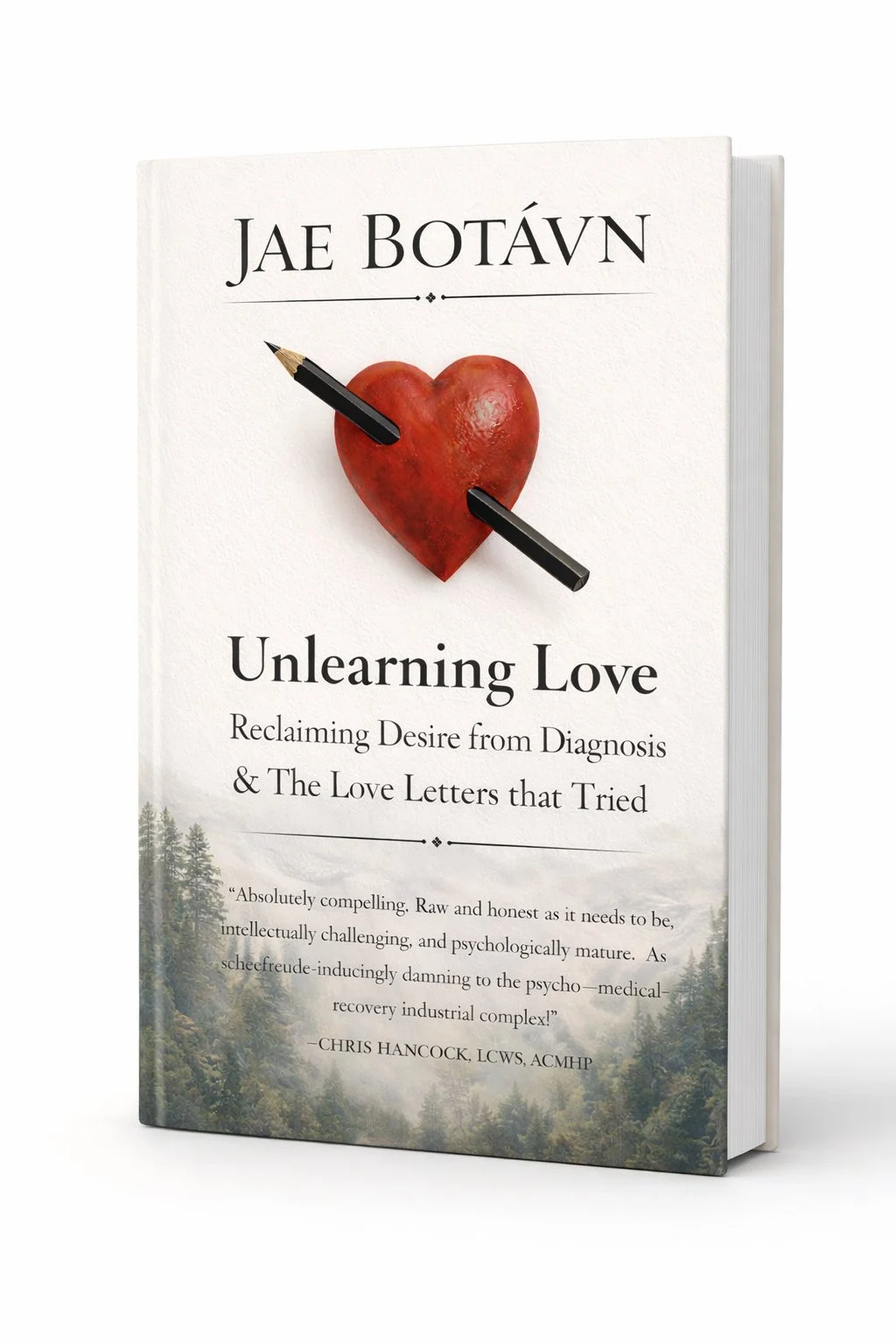
UNLEARNING LOVE
Reclaiming Desire from Diagnosis & The Love Letters that Tried
You've done “the work.” Read the books. Sat in the rooms.
And something still feels deeply, stubbornly off. You can’t put your finger on it, but your intuition is suspicious.
DOWNLOAD A FREE CHAPTER NOW →
No spam. No protocols. Just pages.
This book is for you if —
You know what attachment styles are. You can identify your triggers. You've done the trauma work, the inner child work, the somatic work. You've been told you're codependent, love-addicted, or that the person you loved was a narcissist.
And yet.
The grief did not resolve on schedule. The longing did not respond to the protocol. Something in you keeps returning to an experience the clinical language could label but never quite explain — and you're starting to wonder if the explanation was always the problem.
You're not broken. You're not sick.
You may simply have been handed the wrong map.
What if heartbreak is not a diagnosis?
What if the psycho reductive recovery industrial complex, its labels and its confident prognoses, has colonized the territory of romantic experience, mistaking initiation for disorder, depth for dysfunction, longing for disease, and rupture and repair for addiction or trauma bonds?
What if the soul knows something the system cannot afford to acknowledge?
Unlearning Love is a nearly 500-page memoir and research-backed, mythopoetic inquiry into exactly that question. It does not offer a cure. It does not offer a protocol.
It offers something rarer: a different way of reading your own experience.
A letter from the author, Jae
This book began as private letters to Sarah.
Written at night, in grief, in the aftermath of watching the woman I intended to marry disappear into a treatment system that framed our relationship as her disease — and me as her drug.
I did not write them to be published. I wrote them over the course of around eighteen months to survive the particular loneliness of loving someone in a way that had been officially diagnosed as pathological.
The letters became an inquiry. The inquiry became research — over four years, over 200 academic and peer-reviewed sources. My quest and research became this book.
Because the more I read, the more I found that the frameworks dominating the modern relationship economy — love addiction, codependency, narcissistic abuse, trauma bonding, attachment styles — were not the medical realities they were presented as. They were social constructions. Useful, sometimes. But not maps of the soul.
And the people who had built empires on these constructions had a vested interest.
I am not a therapist. I am a graduate researcher in depth psychology, and a man who loved someone past the point of clinical approval, and who spent four years trying to understand whether that made him pathological, or simply a devoted human.
This book is what I found.
Warmly,
Jae Botávn, MA(c), Depth Psychology
DOWNLOAD A FREE CHAPTER NOW →
Read the first chapter free. No commitment. No prescription.
A glimpse inside
PART I — From Chapter IV
"The dominant narrative had won. We were not two sovereign humans trying to love each other through our wounds. We were a patient and a pathology. She was the victim. I was the drug. The treatment was elimination. And the chaperone — kind, professional, certain — was the authority who knew better than we did what was real.”
PART II — From Chapter XI
"She slept the way children sleep, head tucked beneath my chin, her wrist so small I could close my hand around it with room to spare. I loved the tiny constellations on her stomach, beauty marks formed Orion's belt, and the way her hands, elegant and capable, fit mine like puzzle pieces. She made soft sounds like a baby cooing when I spoke, which let me know the words were entering her being, not just her ears."
PART III — From Letter One to Jae from Sarah
"I just want to be HOME with you again. You are my home. I could literally die a happy woman lying on your chest, on a recliner in a farmhouse somewhere. Take me there, and let me drool on you indefinitely."
PART IV — From Letter Eleven to Sarah from Jae
"The woman who wrote that note was a lifelong dream come true for me. For a fleeting moment, she wasn't just a dream — I saw her, held her, kissed her, fought for her, believed in her. I asked her to grow, to step into her radiance. I made promises to her and asked her to grow old with me. I waited for her. I loved her."
What the book examines
A careful dismantling of the concepts dominating modern relationship discourse — love addiction, codependency, narcissism, trauma bonding, attachment styles — traced to their origins, tested against the clinical literature, and revealed as cultural constructions rather than medical realities. Not to dismiss suffering. To restore precision to language that has been stretched until it explains everything and therefore nothing.
An alternative cartography drawn from depth psychology — Jung, Hillman, von Franz, Woodman, Johnson, Singer — that reads the symptoms of heartbreak as symbols, the chaos of passion as an alchemical process, and the beloved as a figure in the soul's own drama of becoming.
The actual letters — hers and mine — written in real time, unedited except for grammar, offered not as literary artifact but as proof that this work rises from lived experience, not theoretical distance.
Nearly 500 pages. Over 200 scholarly references are pinned between raw memoir and theory. Zero prescriptions
Inside the book
Part I — Rubedo: The Reddening
Scarlet Letter — On the violence of labels
Beyond Labels — When the map becomes a cage
Therapeutic Fortune Telling — How psychotherapiutic jargon drifts into self-fulfiled prohphecy
The Erasure — What happens when a relationship is reduced to psychopathology
Invented Realities — The cognitive architecture of borrowed belief
Stats & Rats — What the research actually says
Coaches & Cults — How comodifying healing became a profitable industry of harm
Part II — Nigredo: The Blackening
Myth & Meaning — Distinguishing living myths from diagnostic stories
Symptom or Symbol — Two languages for the same pain
A Frog Prince — A fairy tale reread that reveals a hidden instruction
A Snow White — The devouring mother, the seven disordered dwarfs, and the kiss that is not what you think
Dialectical Alchemy — Practical tools for holding what cannot be resolved, only transformed
Interlude — Between Knowing and Awakening
Part III — Albedo: The Whitening
Sarah's letter to Jae — then his first letters back, written inside the collapse
Part IV — Citrinitas: The Goldening
Jae's final letters — written across a year of silence, therapy, and refusal to let go
Epilogue — A Letter to My Ex-Girlfriend's Future Boyfriend
Appendix — Four academic essays, including:
How Two Women Invented the Love Addiction and Codependency Myth
The Profit-Driven Addiction Treatment Industry: A Documented Ethical Crisis
Are 12-Step Programs Cults? An Analysis Through Established Frameworks of Thought Reform
Twelve-Step Enactment Facilitation Within Borderline and Disorganized Attachment
Glossary
Depth Psychology Terms
The longing that brought me to the page was not a sickness.
It was a teacher.
If you are holding your own unfinished story — if you have been told that your heart's persistence is a pathology rather than a pilgrimage — this book will help you reclaim your love life and restore your psychological sovereignty.
It offers a company. It offers questions. It offers answers.
It offers an open door.
And it offers this: You are not alone in the fire.
DOWNLOAD A FREE CHAPTER NOW →
Available 2026. Get the first chapter today.
Join readers who are done being diagnosed and ready to be understood.